

Transcript
Evan Dumas
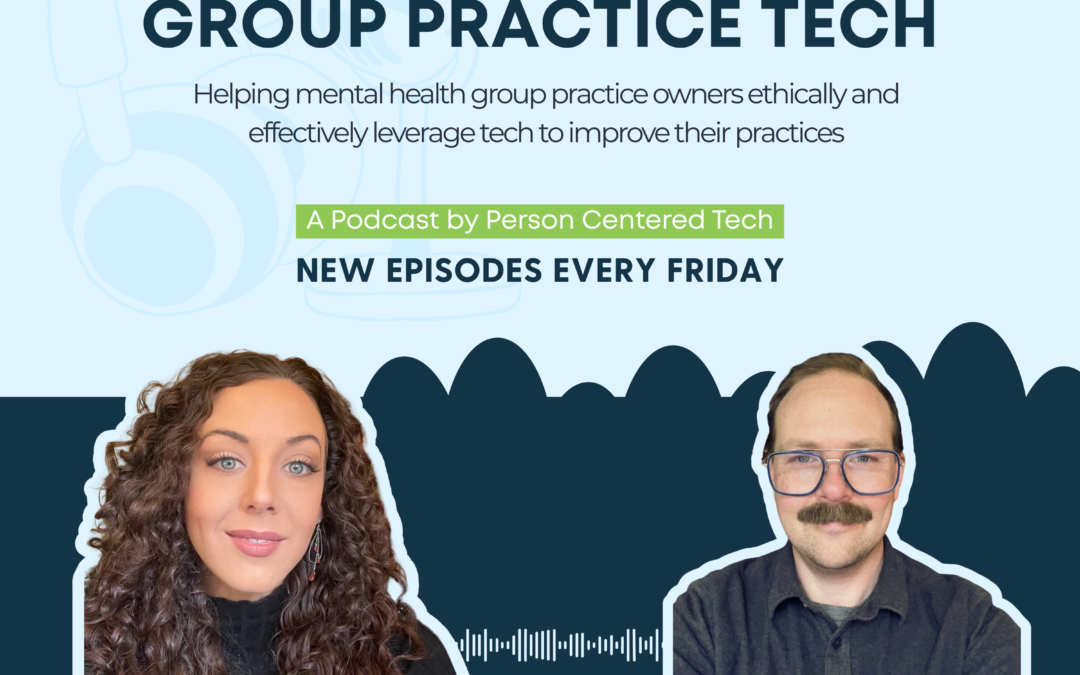
You’re listening to Group Practice Tech, a podcast by Person Centered Tech, where we help mental health group practice owners ethically and effectively leverage tech to improve their practices. I’m your co-host, Evan Dumas.
Liath Dalton
And I’m Liath Dalton, and we are Person Centered Tech.
Liath Dalton
This episode is brought to you by Therapy Notes. Therapy Notes is a robust online practice management and electronic health record system to support you in growing your thriving practice. Therapy Notes is a complete practice management system with all the functionality you need to manage client records, meet with clients remotely, create rich documentation, schedule appointments and bill insurance all right at your fingertips. To get two free months of Therapy Notes as a new Therapy Notes user go to therapynotes.com and use promo code PCT.
Evan Dumas
Hello and welcome to Episode 541: Five Stories We’re Grateful For This Season (and Why They Matter to Mental Health Providers).
Liath Dalton
Hi everybody. Thank you so much for joining us, and we thought that, you know, in a year where we have talked so much about things that are challenging and don’t always have an easy solution, and where we’re reflecting on the gratitude that we have for the community that we get to interface with and support, that we would talk about some of the bright spots in things.
Liath Dalton
So we’re just going to kind of give a broad overview of what those stories are and why they are impactful, and like what the challenges that they are kind of speaking to, in terms of your practice. And hopefully hearing some of this brings a little peace of mind and reassurance to you, as you’re navigating all of the challenges that you face in your practice. So let’s get to it.
Evan Dumas
Yeah.
Liath Dalton
All right, so like I feel as though, for the past couple of years, we have been talking so much about the threats, primarily, the threats that AI poses to mental health practitioners, because of how it’s being utilized, how it’s being managed, all of those things. And one bright spot that we are seeing is really that, even though, on the federal level, we haven’t seen a lot of regulation that’s providing clarity, both the ethics codes have started to specifically address AI use, and states have started enacting laws that put requirements regarding transparency, consent, data, use limits, all of those good things on to the vendors.
Evan Dumas
Yeah.
Liath Dalton
So we’re getting to a point where the pressure is starting to shift away from clinicians and on to the service providers.
Evan Dumas
Yeah.
Liath Dalton
And that’s really beneficial. So it makes it easier to, if you are going to incorporate AI use into your practice in any way, it makes it easier to now start being able to identify which service providers are going to be more likely to meet your needs because they’re either subject to the laws or are, you know, providing more transparency, right?
Evan Dumas
Mhm, mhm.
Liath Dalton
And then another fantastic thing that has occurred in the in the community, although it’s, it’s one of, it’s, it’s very nascent, super nascent, right?
Evan Dumas
The most nascent and minimal it can be.
Liath Dalton
But it portends good things to come. And what we’re talking about is specifically cross jurisdictional licensure portability, slash practice permissions expansion, and that being sort of more accessible to folks.
Evan Dumas
Mhm, yeah.
Liath Dalton
And and, and that’s something that the compacts provide, and like PSYPACT, has expanded even further over the course of this last year, which is fantastic, and currently that is the only really in material terms, in effect compact. But, the Counseling Compact has their system operational, and two states are now active within it.
Evan Dumas
Mhm.
Liath Dalton
And the fact that it’s only two states means it’s like really minimally impactful for the vast majority of you,
Evan Dumas
Yeah.
Liath Dalton
But the fact that they have two that are in effect, and where you can get practice privileges, does mean that things are moving forward in some, like, tangible way, other than the sort of kicking the can down the road and telling us, oh, it’s coming, it’s coming, we’re working on it.
Evan Dumas
Yeah.
Liath Dalton
And we, we, just wanting to acknowledge we know it’s a massive undertaking. So I’m not throwing shade at the folks who are administering the Compact by any way. I’m excited that it has reached this point,, and we look forward to seeing how all of that materializes in 2026. But, I think PSYPACT actually took longer, like a lot longer, to get operationalized. So the fact that we’re at this point now portends well for the future of the Counseling Compact, in my view.
Evan Dumas
Mhm.
Liath Dalton
And so we’ll, we’ll see how that plays out. But that’s good news,
Evan Dumas
Yeah, yeah, definitely.
Liath Dalton
And we like good news.
Evan Dumas
Yeah, yeah. I mean it’s progress. So we’re just waiting on other states to, sort of, do their application process, and then that compact will just grow and grow.
Liath Dalton
Right.And we know that there are quite a few member states, and they seem to be like growing pretty rapidly as well. So the Counseling Compact will be pretty expansive once it’s fully operationalized, but each state has to go through a whole process of like, data security verification, yada yada.
Evan Dumas
Yeah.
Liath Dalton
Not that the yada yada is that it’s not important, because it definitely is, because it includes like, qualification verification and and so on. But once everyone goes through that process, then it is really going to open things up. And that’s, that’s great news.
Evan Dumas
Yeah, totally.
Liath Dalton
Okay. What’s the next big piece?
Evan Dumas
Yeah, telehealth stability for us, Medicare folks, there is no cliff for the behavioral health, for the in-person requirements, things like that. Thankfully, it keeps being pushed out.
Liath Dalton
Exactly. And the only reason I because, honestly, I think this is the most impactful story. But if last week’s episode hadn’t been entirely devoted to how this wasn’t a cliff, and here’s what the most recent actions mean in practical terms, I would have put this as number one.
Liath Dalton
Because I think it is what like materially impacts the most providers who are listening to this and to the majority of their clients. So the good news is, again, like Evan said, there is no telehealth cliff, and currently the in person requirement for any new clients to be seen prior to their first telehealth visit is not in effect. There is no requirement for that until potentially January 30 of 2026, but what we know from everything that’s just transpired over the last couple of months, and how wonky that’s been, is that the government, despite all of their sort of conflicts and different ideologies and all of that are there’s a degree of consensus about this being something that’s important to their constituents, so that’s great, because that’s a good indicator that it’s going to continue to get extended.
Evan Dumas
Mm, yeah.
Evan Dumas
Yeah, yeah, right, yeah.
Liath Dalton
So obviously, if you’re a telehealth only practice and primarily work with a Medicare population. That’s going to be really significant. But the good news is it got extended. That’s not applicable. So for now, what we know for certain is that between the time you’re listening to this, well actually I shouldn’t say that, because you could listen to this after the fact, potentially speaking. So between now and January 30 of 2026, if you are taking on a new Medicare client, you can see them via telehealth without an in-person visit first.
Liath Dalton
I mean not, not 100% certain. But it’s a good indicator, and that is meaningful, because last time when it did actually expire, what the impact of that was was that you couldn’t see clients, if you hadn’t ,like a new client you couldn’t see, if you hadn’t already seen them in-person. But that was only the case if you were trying to take on new clients after October 1.
Evan Dumas
Yeah, nice,
Liath Dalton
Exactly. All right. Evan, what are a couple other things that are like less regulatory and more in the realm that that we typically are operating within?
Evan Dumas
Yeah. So one of them is really on how security is getting easier and also more adopted. So I do our risk assessments with folks, and one of the biggest takeaways is to turn on two factor authentication. Back in the day, we’d say, you know, turn it on where you can, maybe not a lot of people offer it, but now more and more people are offering it, and it’s easier, and more people are just doing it by default, which is great.
Evan Dumas
There are authentication apps to make the authentication process easier. There’s even passkeys, which are rolling out and making our world of dealing with passwords much easier because of shared trust between devices and just the use of biometrics and a lot of people’s smartphones, etc. So we’re just finding it a lot easier for folks to really follow this sort of security needs, much more easily. And that’s great because, hey, the more we can normalize it, the more we can easy, the more energy we have to put towards other things.
Liath Dalton
Exactly. It’s incredibly beneficial that we are moving into a new era where, yes, there are more risks, but there are also more solutions, and we appreciate that. And when the solutions, this was actually something that we talked about in office hours today, right, Evan?
Evan Dumas
Mhm, yeah.
Liath Dalton
But the solutions aren’t just increasing, like the ease of managing something or how simple it is to log into a system, but they really are improving the security of something.
Evan Dumas
Yeah.
Liath Dalton
So we love seeing that, because I would say that compliance, I mean, I’ve been in this workspace for over a decade now, and the ease with which we can manage a lot of the security standards has improved so dramatically over the last decade.
Evan Dumas
Yeah.
Liath Dalton
Like, truly, it has. So why is that good? Well, that kind of leads into our next next point, right?
Evan Dumas
Yeah, totally Yeah. Sort of practice culture is getting more sustainable. Because of all these tiny little things that were so hard to do, it felt very much like perfectionistic. But now, because compliance is just getting easier, people are getting a chance to focus on, you know, remedying burnout. I mean, we’re out of the, mostly, out of the pandemic, and we’re able to now, oh, take all like a deep breath and carry on with a little bit more ease because of all these supportive systems we have.
Liath Dalton
Exactly. And I’ll say that that’s something like that has created space for more intentionality, and that’s why we have been also shifting some of our continuing education courses towards trainings that are oriented towards more of the clinical side of things. Because, it seems like there’s both increased space and capacity around that and increased desire for trainings in that vein, that feel nourishing to a clinician and aren’t just providing you with tools to support clients, but also that support you as a human.
Liath Dalton
So that’s that’s a major, major positive, and that’s why we are choosing to end on that. Because honestly, in in the whole scheme of things, that just sort of ecosystemic shift is what gives me the most hope. I mean, it’s probably terrible for PCT on a business side, but we didn’t get in this for the money. Clearly, we got in this because we care about the profession and how providers can be supported, and so when they’re when there are things that highlight how that is actually, like, materially tangible and something we can hold on to, I think we need to celebrate that.
Evan Dumas
Yeah.
Liath Dalton
And it’s it has been a tough year for so many, collectively, individually, professionally, personally. So when we have good stories and things that are, you know, positive and lift us up in some way, let’s Let’s all celebrate. So here’s to you, professional mental health practitioners who are doing amazing work in the community. We appreciate you. We are so grateful to be a part of supporting your practices, and will continue to strive to keep you informed and to try and cut through the noise of all all that is out there in this world.
Evan Dumas
Yeah.
Liath Dalton
So thanks for being a part of the PCT community and take good care, and we’ll chat to you next week.
Evan Dumas
Yeah, and talk to you next week, everybody.
Liath Dalton
This has been Group Practice Tech. You can find us at personcenteredtech.com. For more podcast episodes, you can go to personcenteredtech.com/podcast or click podcast on the menu bar.


Your Hosts:
PCT’s Director Liath Dalton
Senior Consultant Evan Dumas
Welcome solo and group practice owners! We are Liath Dalton and Evan Dumas, your co-hosts of Group Practice Tech.
In our latest episode, we share some positive stories to bring you some peace of mind at this time of year.
We discuss:
- Increasing transparency requirements for AI service providers
- Cross-jurisdictional licensure portability/practice permissions expansion
- No telehealth cliff for Medicare clients, and the in-person visit requirement
- How security standards are becoming easier to adopt
- Practice culture becoming easier due to supportive systems

Therapy Notes proudly sponsors Group Practice Tech!
TherapyNotes is a behavioral health EMR/EHR that helps you securely manage records, book appointments, write notes, bill, and more. We recommend it for use by mental health professionals. Learn more about TherapyNotes and use code “PCT” to get two months of free software.
*Please note that this offer only applies to brand-new TherapyNotes customers
Resources for Listeners
PCT Resources:
- TBD
Group Practices
Get more information about how PCT can help you reach HIPAA compliance while optimizing and streamlining your practice.
Solo Practitioners
Get more information about how PCT can help you reach HIPAA compliance while optimizing and streamlining your practice.