
3 CE Credit Hour Presentation on Intervention Documentation
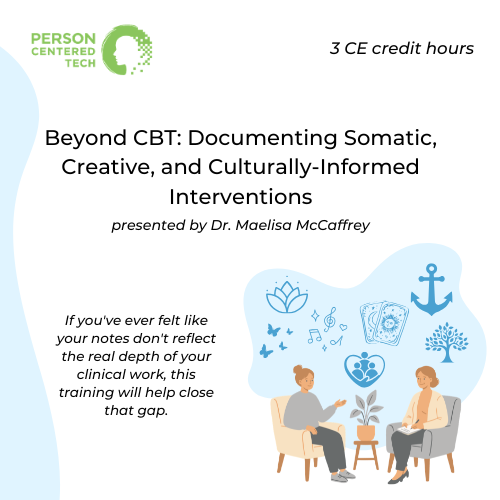
Beyond CBT: Documenting Somatic, Creative, and Culturally-Informed Interventions
Presented by Dr. Maelisa McCaffrey
You’re using more than CBT in session — somatic work, polyvagal-informed approaches, parts work, attachment-focused interventions, mindfulness, creative tools, culturally-informed practices — and it’s working. But when it’s time to write the note, you’re stuck translating it into language that doesn’t quite fit, wondering if insurance will even understand what you did, or pay for the care your client actually needs.
Monday, July 27, 2026
10AM – 1:30 PM Pacific
11AM – 2:30 PM Mountain
Noon – 3:30 PM Central
1:00PM – 4:30 PM Eastern
This is a 3 CE credit hour presentation. The additional 30 minutes in the scheduled time allows for a break during the training; to support everyone’s brains and bodies; as well as space for additional Q&A following the presentation.
Exclusive Workshop Feature
Want to Participate? Be One of Three Live Coaching Volunteers
Three attendees will be selected to receive a live documentation coaching session with Dr. Maelisa McCaffrey during the workshop.
Live and On-Demand
Yes! This training will be recorded and will be available on demand 3-5 days after the event.
Live Documentation Coaching Sessions
One of the highlights of this workshop is watching expert documentation coaching unfold in real time — seeing how the work you do in session can be effectively translated into documentation that truly reflects the care you provide.
Three volunteer clinicians will work with Dr. Maelisa McCaffrey as she coaches them through documenting therapeutic interventions from a recent session in a way that supports medical necessity while remaining authentic to their clinical approach.
To protect client privacy, the coaching sessions will focus on the clinician’s interventions and clinical decision-making — not the client’s story. Selected volunteers will participate by audio only and will receive guidance beforehand on how to discuss their clinical work while avoiding unnecessary client information.
Whether you’re participating or observing, you’ll leave with practical strategies, real-world examples, and language you can immediately apply to your own documentation.
Interested in volunteering? Registered attendees are invited and encouraged to apply. A link to the brief volunteer application will be provided immediately upon registration. Applications close July 17, and selected volunteers will be contacted by Dr. McCaffrey the following week with everything they need for the live coaching session on the 27th.
“Melissa is a stellar presenter and person. The material she prepares for us is brilliant, useful, and adaptable (not to mention thorough). I love the clarity of her mind and way of communicating; just extraordinary. She is trustworthy, i.e. knows how to use her presentation tools, and engagingly friendly. Here’s the kicker for me: I actually started getting excited about moving toward excellence in my charting!! She’s inspiring and brings out the best in people. What a gift she is. Thank you for having her as part of what PCT offers; she’s a Super Asset!!!”
This training is for therapists who want to document the work they’re actually doing, without forcing it into a CBT-shaped box.
You’ll learn how to connect any intervention — no matter how “outside the box” it feels — to medical necessity, using a clear, repeatable framework. You’ll walk through real categories of nontraditional work, including somatic and polyvagal-informed approaches, parts work, mindfulness, creative tools, and culturally-informed practices. And you’ll get live coaching: real clinicians will share what they actually did in session, and you’ll watch that work get translated into documentation in real time.
By the end, you’ll leave with:
- A clear framework for connecting any intervention to medical necessity
- A personalized list of interventions for your treatment plans
- A personalized list of interventions for your progress notes
If you’ve ever felt like your notes don’t reflect the real depth of your clinical work, this training will help close that gap.

Includes Supportive Handouts
- Therapeutic Interventions Workbook
- Sample interventions list
- Interventions framework
- Interventions for treatment plans worksheet
- Interventions for progress notes worksheet
Who is this event for?
This course is designed for solo practitioners, group practice leaders, and group practice clinical staff members. It is also suitable for practices that consist of 100% in-person, 100% telehealth, or a mixture of in-person and telehealth treatment.
 In-person Practices
Hybrid Practices
Teletherapy Only Practices
Target Audience:
This course is intended for licensed mental health professionals, including clinical psychologists, counselors, marriage and family therapists, and clinical social workers, as well as other behavioral health professionals providing clinical services.
Get beyond theory
Explain the purpose of interventions in progress notes and Define active interventions for medical necessity

Personalized Templates
Create a list of personalized interventions to use in a treatment plan template

Progress Notes and Medical Necessity
Create a list of personalized interventions to use in a progress note template
Course Details
3 CE Credit Hour. Self Study
Title: Beyond CBT: Documenting Somatic, Creative, and Culturally-Informed Interventions
Authors/Presenters: Dr. Maelisa McCaffrey, PsyD;
CE Length: 3 CE credit hours
Legal-Ethical CE Hours: 3 CE hour
Educational Objectives:
- Explain the purpose of interventions in progress notes
- Define active interventions for medical necessity
- Create a list of personalized interventions to use in a treatment plan template
- Create a list of personalized interventions to use in a progress note template
Syllabus:
- Introductions and Overview (10 min)
- Interventions in Documentation (20 min)
- Ethical context and purpose
- Progress note vs treatment plan interventions
- Examples of common interventions
- Active vs passive interventions
- Activity: Fix the passive interventions
- The “outside the box” interventions formula
- Somatic & Body-based review
- Experiential & Parts work review
- Mindfulness & Nature-based review
- Creative & Reflective tools review
- Relational & Contextual review
- Other / Emerging Modalities review
Presentation Structure:
This training combines several teaching methods to keep the content practical and engaging:
- Presentation slides — Core concepts including medical necessity, active vs. passive interventions, and the documentation framework for nontraditional work
- Interactive activity — “Fix the Passive Interventions” exercise, where attendees revise sample language together
- Guided practice — Step-by-step application of the interventions formula across six modality categories
- Live coaching demos — Three volunteer clinicians share a recent session, and the presenter coaches them in real time on translating their work into documentation
- Examples and sample phrases — Real, ready-to-use language for each modality category
- Reflection questions — Built into each section to help attendees personalize the material to their own caseload
- Q&A — Extended time at the end for open discussion and individual questions
Live and On-Demand
Meet Our Presenters
Presented by
Dr. Maelisa McCaffrey, PsyD
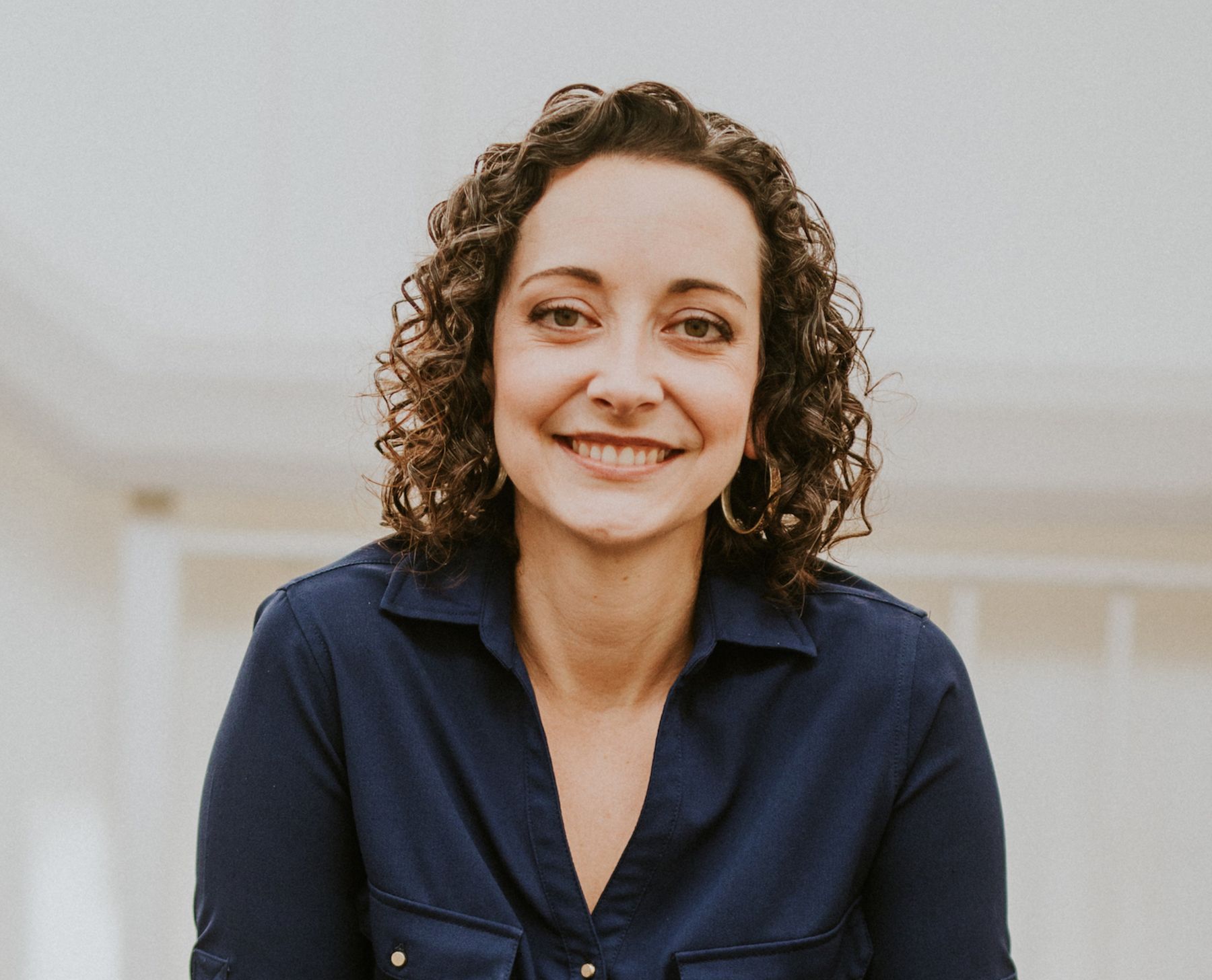
Dr. Maelisa McCaffrey is a licensed psychologist, nail design enthusiast, and author of the book, Stress-Free Documentation for Mental Health Therapists. Through her business QA Prep, she empowers therapists with training and consultation on clinical documentation. Maelisa focuses on the “why” behind the usual recommendations and encourages clinicians to think outside the box, while also keeping their ethics intact. Maelisa aims to make sure all of her endeavors are meeting a need in the community while also allowing for plenty of laughter and fun.
Website/Business Links:
QA Prep https://www.qaprep.com/
Resources & Citations
American Association for Marriage and Family Therapy. (2015). AAMFT Code of Ethics. Alexandria, VA: AAMFT.
American Counseling Association. (2014). ACA Code of Ethics. Alexandria, VA: ACA
American Mental Health Counselors Association. (2020). AMHCA Code of Ethics.
American Psychiatric Association. (2013). Diagnostic and statistical manual of mental disorders (5th ed.). https://doi.org/10.1176/appi.books.9780890425596
American Psychological Association. (2017). Ethical Principles of Psychologists and Code of Conduct (Washington, DC: American Psychological Association, 2017). http://www.apa.org.ethics
Forester-Miller, H., & Davis, T. E. (2016). Practitioner’s guide to ethical decision making (Rev. ed.). Retrieved from (Hyperlink inserted here for space)
Griswold, B. (2022). Navigating the Insurance Maze (9th ed.). Barbara Griswold, LMFT.
Los Angeles County DMH Program Support Bureau Quality Assurance Division. (2010, October 5). Assessments [PowerPoint slides]. https://file.lacounty.gov/SDSInter/dmh/162893_AssessmentsandMedicalNecessity10-05-10.pdf
Medicare. (2024). Medicare and Mental Health Coverage. Medicare Learning Network. https://www.cms.gov/files/document/mln1986542-medicare-mental-health-coverage.pdf
Miller, S., Hubble, M. & Chow, D. (2020). Better Results: Using Deliberate Practice to Improve Therapeutic Effectiveness. American Psychological Association.
National Association of Social Workers. (2021). NASW Code of Ethics. https://www.socialworkers.org/About/Ethics/Code-of-Ethics/Code-of-Ethics-English#principles
National Association of Social Workers. (2005). NASW Standards for Clinical Social Work in Social Work Practice. Washington, DC: NASW.
Pope, K., Vasquez, M., Chavez-Duenas, N., Adames, H. (2021). Ethics in Psychotherapy and Counseling (6th ed.). John Wiley & Sons, Inc.
Schwitzer, A.M. & Rubin, L.C. (2015) Diagnosis & Treatment Planning Skills. Thousand Oaks, CA: SAGE Publishing.