

Transcript
[Transcript] Episode 518: Mental Health Parity on Pause: What the Final Rule Non-Enforcement Means for Providers
Evan Dumas
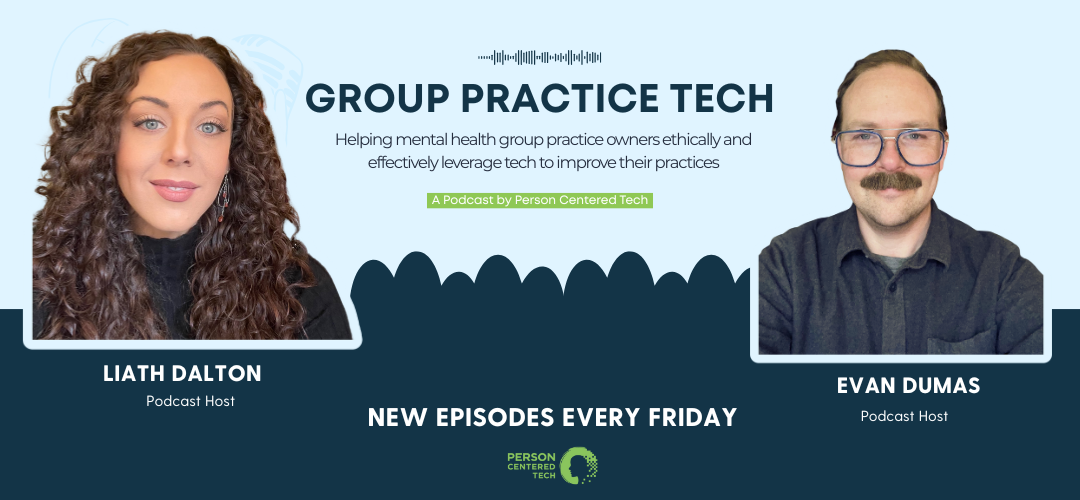
You’re listening to Group Practice Tech, a podcast by Person Centered Tech, where we help mental health group practice owners ethically and effectively leverage tech to improve their practices. I’m your co-host, Evan Dumas.
Liath Dalton
And I’m Liath Dalton, and we are Person Centered Tech.
Liath Dalton
This episode is brought to you by Therapy Notes. Therapy Notes is a robust online practice management and electronic health record system to support you in growing your thriving practice. Therapy Notes is a complete practice management system with all the functionality you need to manage client records, meet with clients remotely, create rich documentation, schedule appointments and bill insurance all right at your fingertips. To get two free months of Therapy Notes as a new Therapy Notes user go to therapynotes.com and use promo code PCT.
Evan Dumas
Hello and welcome to Episode 518 Mental Health Parity on Pause: What the Final Rule Non-Enforcement Means for Providers.
Liath Dalton
Yes. This is one of those episodes that we kind of approach with a somewhat heavy heart, because this context of deregulation and non-enforcement of existing regulations has a lot of implications.
Liath Dalton
But the good news is that the implications of this Final Rule non-enforcement are not as scary as it might sound and seem on face value. So we’re going to unpack what the recent announcement that federal agencies will not enforce key elements of the 2024 Final Rule under the Mental Health Parity and Addiction Equity Act. We’re going to just refer to that as the Parity Act, because it is quite a mouthful, and the acronym MHPAEA does not really roll off the tongue.
Evan Dumas
No.
Liath Dalton
So, the Parity Act. And we’re going to look at what this means for mental health practitioners, how it intersects with ongoing requirements under earlier parity regulations, and then kind of look at the broader implications for client access to care and insurance coverage.
Liath Dalton
So to begin, the context of all of this is that just a few days ago at the time of recording, on May 15, 2025, regulators paused enforcement of new parity rules, which understandably then raises questions for providers.
Liath Dalton
So essentially, the Parity Act’s, original purpose was to ensure that mental health and substance use disorder benefits are treated no less favorably than medical or surgical benefits.
Evan Dumas
Mhm, yeah.
Liath Dalton
So going back to where this Parity Act began, and it’s, kind of, history, because this addresses also what the regulations that are still in effect, are which is what’s really most significant. The Parity Act was first enacted in 2008 and prohibits benefit discrimination for mental health services compared to physical health care. It doesn’t require that insurance covers mental health, but if they do, the coverage and limitations have to be equitable or comparable to physical healthcare benefits.
Evan Dumas
Mhm.
Liath Dalton
So then the sort of initial Final Rule of that Parity Act that was first enacted in 2008, the additional elements that were enacted in 2013 require equal application of financial requirements, so like co pays and deductibles, quantitative limits, like session caps and then the next piece of it is non-quantitative treatment limitations or NQTL, so those are like prior authorization or medical necessity reviews.
Evan Dumas
Mhm.
Liath Dalton
And this all applies across six benefit classifications for inpatient and outpatient, in and out of network, emergency care and prescription drugs. So the implications for providers are that they help you to challenge unfair insurance restrictions related to mental health and substance use disorder care, and help equip you to support clients in filing appeals. Also provides the basis for you to identify and report parity violations, and, very importantly, advocate for appropriate coverage and access.
Liath Dalton
So that’s what is all in place and has not changed. And I want to emphasize that. That is all still in effect, which is great, but let’s talk about what was in the 2024 Final Rule, and why it’s now on hold.
Liath Dalton
So the 2024 Final Rule had some key provisions. Notably a fiduciary certification, which required plan sponsors to attest that they used prudent processes to ensure parity compliance, and then a meaningful benefits requirement, which basically was trying to ensure that insurers were offering real access to mental health and substance use disorder treatment, not just technical compliance.
Liath Dalton
And one area of application for that, that a lot of us had a lot of hope around, was that part of the meaningful benefits requirement would mean that they needed to have a sufficient number of in network mental health and substance use disorder providers to meet the needs of the folks on the plan, right?
Evan Dumas
Yeah.
Liath Dalton
That it’s not a meaningful benefit if there aren’t actually providers in network to offer the care. And then it also had stricter NQTL oversight, so it proposed more rigorous database parity analyses and documentation.
Liath Dalton
Of course, the plan sponsors, the insurance companies, were not too thrilled about these requirements.
Evan Dumas
No.
Liath Dalton
And so the ERISA industry committee filed a lawsuit that challenged the legality of the fiduciary certification mandate, and then in response, the federal regulators decided to pause the enforcement of all the new provisions in the 2024 rule.
Liath Dalton
So again, what is paused is just the new provisions from the 2024 rule. The 2013 regulations and the 2021 NQTL comparative analysis requirements are still enforceable, and that’s really important. So then, in terms of now that we have the sort of scene set, what are the implications for providers and for your practice operations?
Liath Dalton
Well, the pieces that are on hold, the new compliance requirements are not going to be enforced. So this could result in plans delaying enhancements to mental health and substance use disorder coverage in the absence of enforcement pressure. But what’s still required is that the 2013 parity regulations are still in effect, and the comparative NQTL analysis mandates from the 2021 Consolidated Appropriations Act remain active.
Liath Dalton
And then above and beyond that, because all of this that we’ve been discussing thus far is on the federal level, federal regulation.
Evan Dumas
We’ve got good news.
Liath Dalton
Yes. What is that good news, Evan?
Evan Dumas
Yeah. So thanks to our wonderful organization of states and federal, states can have stronger parity protections, and a few do, and a few can more down the road too.
Liath Dalton
Exactly. So some examples of states that have stronger parity protections are California, New York, Massachusetts. Like California, requires coverage of all medically necessary medical mental health and substance use services. New York has something similar and mandates specific network advocacy benchmarks. Which that’s an interesting application of it, because that’s kind of going after the meaningful benefit standard that was in the federal 2024 rule, right?
Liath Dalton
And then Massachusetts also has requirements related to network access and utilization review parity, which are pretty great. So even with the federal pause, state laws can still mandate higher standards of parity and transparency.
Liath Dalton
So what you can do as a provider is stay really alert related to denials and limitations in coverage, you can monitor for inconsistencies between mental health and medical benefit administration and then leverage whatever state specific tools are available to you, including ombudsman services for client support and system accountability.
Liath Dalton
And then to kind of look at this in a with a lens oriented to equity, access and ethics,
Evan Dumas
Yeah.
Liath Dalton
this, this, you know, really speaks to access to care, and who is going to be most impacted by lack of parity. So now that we’re in this kind of gray zone without further federal enforcement, there may be some growing inconsistency between insurance plans and across states in terms of parity application.
Evan Dumas
Mhm.
Liath Dalton
And some insurers may really pull back on parity efforts, which can, of course, then affect client access to care.
Liath Dalton
As always, the unfortunate reality is that the most vulnerable populations are going to be the most impacted, so folks with limited plan options may see reduced mental health and substance use disorder coverage and that inadequate coverage can really exacerbate inequities, especially for children, for rural clients, for people with chronic or complex conditions, and of course, folks on a lower socio-economic status scale.
Liath Dalton
So it’s really important for providers to be balancing their clinical care with transparent discussions about coverage realities, and to advocate when necessary or possible, to help ensure equitable care.
Liath Dalton
And then this is a moment where it is really important to participate in policy conversations as a provider and stay engaged with whatever advocacy efforts around parity that your professional organizations offer.
Liath Dalton
And in the context of the, sort of, solution to this challenge, really being at the state level, rather than the federal level. That’s a place where your voice really matters, so use it and get engaged with whatever parity advocacy efforts are going on on a state level.
Evan Dumas
Mhm.
Liath Dalton
And of course, involvement and advocacy can range from, you know, just letting your professional organization know that this is something that you feel is very important and you support their work in whatever, you know, petitions or things that you can sign, to add your your name and voice to their efforts. That’s one option. And then, of course, you can get even more involved. But this is something that is so impactful to client care, and to the profession, and continued viability of the profession in a insurance based model, that it’s not something that we can just sort of be passive about. That’s, that’s my view.
Evan Dumas
Yeah.
Evan Dumas
Yeah, no. Gotta get involved.
Liath Dalton
Gotta get involved. Yes, and honestly, to put the sort of silver lining spin on things. In a world where it feels like there is so much that is beyond our control, and a lot that we would like to be able to make different, here is something that you can have an impact and can help shape things in a way that is meaningful and can provide real benefit to the entire, you know, community, all of the the citizens in your state. So it’s worthwhile.
Liath Dalton
So again, just to kind of sum up, what remains in effect are that despite the pause of the 2024 rule, the original 2013 parity rule and the 2021 NQTL compliance requirements are still in place and are still going to have to shape insurance behavior. And though big emphasis on the and you as a provider should really use those rules to challenge inequitable treatment limitations whenever they arise.
Evan Dumas
Mhm.
Liath Dalton
So what you want to be doing is stay informed on policy developments and enforcement changes, support your clients in appeals and parity related complaints, and collaborate with advocacy organizations and share systemic concerns.
Liath Dalton
We’re going to be linking in the show notes to a number of helpful resources. One is just the Department of Labor’s Parity Act Info Center. The other is the Kennedy Forum’s Parity Resource Guide.
Liath Dalton
It’s kind of funny that it’s the Kennedy Forum, and it was Senator Patrick Kennedy, who introduced the Mental Health Parity Equity Act in the first place. And now it’s a different Kennedy who’s the head of HHS and doing things that so far seem like they are in opposition to this. But I digress.
Liath Dalton
The Kennedy Forum’s Parity Resource Guide is excellent. And then there are also some state specific, there’s a resource called Parity Track, and it has the state specific info. So check those resources out in the show notes. And we’ve also put together a little parity checklist for you, to just guide you in being able to navigate issues related to parity within your practice in a kind of operational sense, so check out that download resource as well.
Liath Dalton
Thanks for listening and keep up the good fight. We appreciate all that you do, and hope that this is supportive of one aspect of the work that you are doing. We’ll chat to you next week.
Evan Dumas
Yeah, talk to you next week, everybody.
Liath Dalton
This has been Group Practice Tech. You can find us at personcenteredtech.com. For more podcast episodes, you can go to personcenteredtech.com/podcast, or click podcast on the menu bar.


Your Hosts:
PCT’s Director Liath Dalton
Senior Consultant Evan Dumas
Welcome solo and group practice owners! We are Liath Dalton and Evan Dumas, your co-hosts of Group Practice Tech.
In our latest episode, we unpack what mental health providers need to know about the recently announced non-enforcement of the 2024 Final Rule of the Mental Health Parity and Addiction Equity Act.
We discuss:
- The history and purpose of the Parity Act
- What has not changed with the Parity Act
- Key provisions of the 2024 Final Rule
- The implications of the non-enforcement of this rule
- State laws and states with stronger parity protections
- What you can do as a provider to advocate for parity
- Resources on parity we recommend
Sign Up For Updates
Get a monthly digest with the month’s episodes and resources delivered to your inbox.

Therapy Notes proudly sponsors Group Practice Tech!
TherapyNotes is a behavioral health EMR/EHR that helps you securely manage records, book appointments, write notes, bill, and more. We recommend it for use by mental health professionals. Learn more about TherapyNotes and use code “PCT” to get two months of free software.
*Please note that this offer only applies to brand-new TherapyNotes customers
Resources for Listeners
Resources & further information
Resources:
- U.S. Department of Labor MHPAEA page
- The Kennedy Forum Parity Resource Guide
- Parity Track (state-specific info)
- APA Mental Health Parity Efforts
- NASW Parity Policy Efforts
- ACA 2025 Policy Agenda
- AAMFT Federal Advocacy Efforts
PCT Resources:
- Parity Checklist for Providers
- Group Practice Care Premium
- weekly (live & recorded) direct support & consultation service, Group Practice Office Hours — including monthly session with therapist attorney Eric Ström, JD PhD LMHC
- + assignable staff HIPAA Security Awareness: Bring Your Own Device training + access to Device Security Center with step-by-step device-specific tutorials & registration forms for securing and documenting all personally owned & practice-provided devices (for *all* team members at no per-person cost)
- + assignable staff HIPAA Security Awareness: Remote Workspaces training for all team members + access to Remote Workspace Center with step-by-step tutorials & registration forms for securing and documenting Remote Workspaces (for *all* team members at no per-person cost) + more
- HIPAA Risk Analysis & Risk Mitigation Planning service for mental health group practices — care for your practice using our supportive, shame-free risk analysis and mitigation planning service. You’ll have your Risk Analysis done within 2 hours, performed by a PCT consultant, using a tool built specifically for mental health group practice, and a mitigation checklist to help you reduce your risks.
Group Practices
Get more information about how PCT can help you reach HIPAA compliance while optimizing and streamlining your practice.
Solo Practitioners
Get more information about how PCT can help you reach HIPAA compliance while optimizing and streamlining your practice.