

Six years into the rapid expansion of telehealth, cross-jurisdictional practice is no longer an unusual exception. It is now part of ordinary mental health client care delivery.
Clients travel. They go to college out of state. They relocate after a separation or divorce. They spend part of the year with family. They temporarily stay in another state for work, caregiving, medical care, or safety. Some move internationally. Clinicians travel too. They maintain hybrid practices, work remotely, pursue licenses in multiple states, participate in licensure compacts, or consider moving abroad while continuing to provide telehealth to clients in the United States.
These scenarios are now common.
The problem is that many clinicians are still approaching them with a question that is too narrow:
“Am I legally allowed to practice there?”
That is an essential question. But it is not the only question.
In cross-jurisdictional telemental health practice, legal permission is only the starting point. The harder question is often:
“What requirements apply once I am practicing across jurisdictions — and can I actually meet all of them?”
That is where many of the blind spots appear.
Cross-jurisdictional practice is not simply a licensure issue
Licensure matters. Practice authority matters. Temporary practice allowances, registration pathways, and compact privileges matter. A clinician needs to know whether they are authorized to provide services when the client is physically located in another jurisdiction.
But cross-jurisdictional practice is not simply a licensure issue.
It is also a standards-of-care issue. An ethics issue. A documentation issue. A privacy and security issue. A payer issue. A malpractice coverage issue. A records issue. A mandatory reporting issue. An emergency planning issue. And, in many cases, a minors and parental rights issue.
A clinician may be focused on whether a state allows temporary practice, but that same state may also have different requirements for telehealth documentation, client location verification, record retention, parental access to records, duty to warn or protect, mandated reporting, or emergency response planning.
So the analysis cannot stop at:
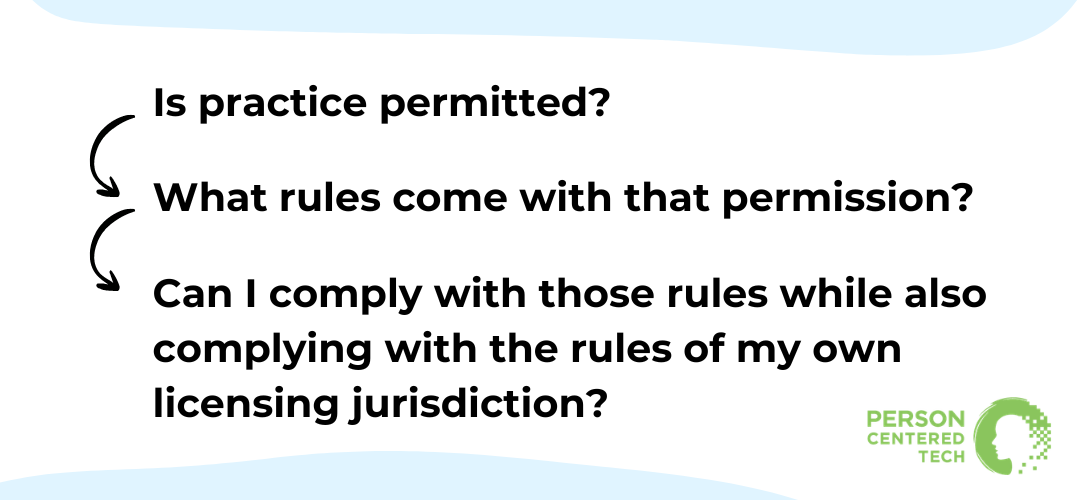
“Is practice permitted?”
It has to continue into:
“What rules come with that permission?”
and:
“Can I comply with those rules while also complying with the rules of my own licensing jurisdiction?”
That second layer is where ordinary telehealth scenarios can become unexpectedly complex.
When the client travels, what changes?
A familiar example: a client who normally lives in the clinician’s licensed state travels to another state for a few weeks and wants to continue sessions.
This is often framed as a continuity-of-care issue, and clinically, that may be exactly what it is. The therapeutic relationship is established. The client is temporarily away. Telehealth makes continued care possible.
But the legal-ethical analysis still needs to be done.
Questions may include:
- Is the client physically located in a jurisdiction that regulates the service being provided?
- Does that jurisdiction require local licensure, registration, compact privilege, or temporary practice permission?
- Does the jurisdiction allow temporary practice for the clinician’s profession?
- Are there limits on the number of days, sessions, or circumstances?
- Are there telehealth-specific documentation requirements?
- Does the clinician need to verify and document the client’s physical location at each session?
- Are emergency resources identified for the client’s temporary location?
- Does the client’s payer cover services while the client is physically located there?
- Does the clinician’s professional liability coverage apply?
The clinical reason for continuing care may be strong. But the clinician still needs to know what legal, ethical, payer, and documentation requirements attach to the client’s temporary location.
Live and On Demand
When a compact is available, what does it actually allow?
Licensure compacts can be an important pathway for cross-jurisdictional practice, but they do not make cross-border care automatic or unlimited.
A clinician may need to ask:
- Is the compact actually active and operational for my profession?
- Has my state joined the compact, and has the client’s state joined?
- Do I need to apply for and receive a specific compact privilege or authorization before practicing in that state?
- Does the compact privilege apply to telehealth, in-person practice, or both?
- Does it apply only from a designated home state or from wherever I happen to be physically located?
- Are there state-specific laws, board rules, documentation requirements, or standards of care that still apply even when compact authority exists?
- Does the compact address payer requirements, malpractice coverage, emergency planning, minors, consent, confidentiality, or records access — or do those still need to be analyzed separately?
Compacts can reduce barriers to legal practice authority, but they do not eliminate the need for jurisdiction-specific due diligence. A compact may answer one question — “Do I have a pathway to practice with clients in this state?” — while leaving many other legal, ethical, clinical, documentation, payer, and risk-management questions unanswered.
When the clinician travels, what changes?
A second common blind spot arises when the client remains in the state where the clinician is licensed, but the clinician travels elsewhere.
Many clinicians assume that if the client is physically located in the state where the clinician is licensed, the analysis is complete.
Sometimes that may be largely true. But not always.
The clinician’s physical location can matter too.
Before providing sessions while traveling out of state, clinicians may need to ask:
- Does the jurisdiction where I am physically located regulate the provision of telehealth services from within its borders?
- Does my own licensing board allow me to practice while physically located elsewhere?
- Does my malpractice policy cover me when I am providing services from another state?
- Does the client’s payer impose restrictions based on clinician location?
- Am I able to maintain privacy, security, records access, and emergency response workflows while traveling?
- Is my telehealth environment consistent with my ethical and professional obligations?
This is where “care occurs where the client is located” can become an oversimplified assumption. Client location is critically important, but it may not be the only legally or ethically relevant location.
When the clinician is outside the United States
The questions become even more layered when a U.S.-licensed clinician travels outside the country or relocates abroad while continuing to provide telehealth services to clients in the United States.
This scenario is increasingly common. It may seem straightforward at first: the clinician is licensed in the client’s state, the client remains in the United States, and sessions continue by telehealth.
But international practice introduces additional questions:
- Does the clinician’s U.S. licensing board address practice while physically located outside the country?
- Does the country where the clinician is located regulate counseling, psychotherapy, or mental health services?
- Is the clinician’s practice there clearly permitted, merely not prohibited, or unclear?
- Does the clinician’s malpractice coverage apply while practicing from outside the United States?
- Do payer contracts allow reimbursement when the clinician is physically abroad?
- Are there privacy, security, or data transfer considerations?
- Can the clinician maintain access to records, secure communication, and required documentation systems?
- Can the clinician respond appropriately to clinical emergencies from another country?
- Are there tax, business registration, or professional practice implications in the country where the clinician is located?
Internationally, the distinction between “not prohibited” and “authorized” becomes especially important. A country may not regulate a clinician’s profession in the same way a U.S. state does. That does not necessarily mean the clinician has the same legal recognition, professional protections, emergency response infrastructure, confidentiality protections, or malpractice support they are used to relying on.
The question is not only:
“Can I technically do this?”
It is also:
“Can I meet the legal, ethical, clinical, privacy, documentation, and risk-management obligations that come with doing this?”
When the client is a minor
Some of the most complicated cross-jurisdictional scenarios involve minors.
That is because “permission to practice” may be the simplest part of the analysis. The harder issues may involve consent, assent, confidentiality, parental rights, custody orders, record access, mandatory reporting, and the age at which a minor can independently authorize or control aspects of care.
Consider the kinds of questions that may arise when a minor client is physically located in a different state:
- What is the age of majority in that jurisdiction?
- Can a minor consent to outpatient mental health treatment there?
- At what age, and under what circumstances?
- Does that jurisdiction distinguish between consent and assent?
- Who has the right to authorize treatment?
- Who has the right to terminate treatment?
- Who has the right to access the minor’s records?
- Do both parents have decision-making authority, or only one?
- Is there a custody order or parenting plan that changes default parental rights?
- Does the clinician’s own licensing jurisdiction impose different requirements?
- What happens if one jurisdiction gives a parent access to records while another protects the minor’s confidentiality?
- What happens if complying with one state’s rule creates risk under another state’s rule?
These are not abstract concerns. These are the kinds of issues that can arise in ordinary family therapy, adolescent therapy, college student care, custody transitions, relocation, or blended-family situations.
And they illustrate why cross-jurisdictional practice cannot be reduced to a binary permission question.
A clinician may have a route to practice in the state where the minor is physically located. But if the consent, confidentiality, and records-access rules conflict with the clinician’s home-state obligations, the real question becomes:
“Can I comply with all applicable requirements at the same time?”
Sometimes the answer may be yes. Sometimes it may require consultation, additional documentation, adjusted workflows, or a more conservative clinical plan. And sometimes the conflict may be serious enough that the clinician cannot responsibly proceed without further legal guidance.
When requirements conflict
One of the most important shifts in cross-jurisdictional practice is recognizing that the problem is not always a lack of permission.
Sometimes the problem is conflicting obligations.
A clinician may need to consider:
- What does my licensing jurisdiction require?
- What does the client’s physical-location jurisdiction require?
- What does the jurisdiction where I am physically located require?
- What does the payer require?
- What does my malpractice carrier cover?
- What do my ethics code and standard of care require?
- What do my informed consent, policies, and documentation practices say?
- If these requirements differ, can I satisfy all of them?
- If they conflict, which requirement controls?
- Is this a situation where I need legal, ethics, board, payer, or malpractice consultation?
In lower-risk situations, the answer may be manageable. For example, if one jurisdiction requires more specific record-retention planning than another, the clinician may be able to follow the stricter or more specific rule.
But not every conflict can be solved by “following the stricter rule.”
Some conflicts involve incompatible duties: one jurisdiction’s confidentiality protection may not align with another jurisdiction’s access or reporting requirement. One state’s approach to minor autonomy may differ sharply from another’s. One payer’s requirements may be narrower than what licensure law permits. One jurisdiction may recognize a clinician’s role or profession differently than another.
That is why a framework matters.
The role of documentation
Documentation is not just a defensive exercise. It is part of competent cross-jurisdictional practice.
Clinicians need a way to document:
- which jurisdictions were implicated
- what authority to practice was relied upon
- what rules, statutes, board guidance, compact requirements, or policies were reviewed
- when the information was reviewed
- what limitations or uncertainties were identified
- whether consultation was obtained
- how client location and emergency resources were verified
- what informed consent updates were needed
- how continuity of care was considered
- what decision was made and why
This is especially important because cross-jurisdictional rules change. Board guidance changes. Compact implementation changes. Temporary practice allowances change. Payer policies change. Enforcement priorities change.
A clinician does not need to pretend the landscape is simple. But they do need to be able to show that they identified the relevant issues, sought appropriate information, and made a reasoned decision.
The questions are the point
The goal is not to make cross-jurisdictional practice feel impossible.
It is to make sure clinicians are asking the full set of questions before assuming that telehealth flexibility solves the legal-ethical analysis.
Modern telemental health practice requires more than knowing whether practice is permitted or not prohibited. It requires understanding what requirements apply, whether those requirements can be met, whether they conflict with other obligations, and how the clinician will document the analysis.
That is the difference between a basic permission analysis and a responsible cross-jurisdictional practice framework.
These are the kinds of questions we address in Legal-Ethical Cross-Jurisdictional Telemental Health in 2026: Interstate, International, and Complex Practice Considerations, presented by Eric Ström, JD, PhD, LMHC and Liath Dalton.
This course is designed to help mental health professionals move beyond oversimplified yes/no answers and toward practical, documented, ethically grounded analysis for the real-world cross-jurisdictional scenarios clinicians are encountering now.